
Crocodile facts |

Custom Search
|
Crocodile EvolutionCrocodile ancestors emerged about 220 million years or so, having coexisted with dinosaurs. They survived several major extinctions, including the one that wiped out the dinosaurs, however, many crocodilians have disappeared, some extinct species were huge and in addition to living with the dinosaurs prehistoric crocodiles also hate them.
Together with birds crocodiles, are the closest relatives of dinosaurs living today. Both crocodiles and birds evolved from the archosaurs group, which includes also all extinct dinosaurs. This makes crocodiles more closely related to birds than to other reptiles in the present. Crocodile habits and habitatsCrocodiles are found in the Americas, Africa, Asia and Australia. Crocodiles usually inhabit the margins of rivers, while those from Australia and Pacific islands are also frequently seen in the ocean.
Crocodiles are mostly semi aquatic animals they spend a great deal of time in water, but also need to shore. Depending on the species, crocodiles can be found in rivers, estuaries, coastal regions and even on open sea.
They swim, usually on the surface with eyes and nostrils above the water line and boost their body with the help of their strong tail.
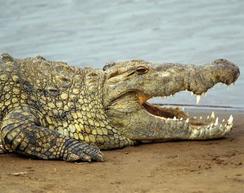
Crocodiles are carnivores, and among them, are big predators such as the Nile Crocodile or the Saltwater crocodile. The Saltwater crocodile is the largest reptile alive today, it can reach up to 7 meters long and more than a ton of weight (1000 kg). Or they can be much smaller, about 1,5 meters for the Dwarf crocodile. Crocodiles are oviparous (they reproduce by eggs that are deposited outside the mothers body) and are the only reptiles that exhibit true parental care. Thus, most of the crocodiles build nests, with heaps of soil or plant debris while other species of crocodiles dig burrows on the banks of rivers or beaches. The female, in general, and sometimes the male remains nearby to protect the eggs from predators. Before the hatching of the eggs, the offspring emits vocalizations (sounds), to which the mother responds digging up the top of the nest to assist the exit of eggs and then holding the newborn in her mouth takes them to the water, protecting them for weeks or months after. 
When juvenile, crocodiles feed on small prey (insects, fish, frogs), but as they grow, they hunt prey larger and larger, until the size of large antelope and even humans.
Man is the major enemy and threat to crocodiles, hunting them, nearly to extinction in some cases, and destroying their natural habitat. Hunters pursue the crocodiles for their valuable skin, much appreciated for making crocodile leather shoes, bags, belts and other crocodile leather products. The crocodile meat is also considered a delicacy in many places. In Africa as in India and Australia, North and South America these large reptiles have been declared protected species and their number is already increasing. Like other reptiles, crocodiles are endothermic animals (cold-blooded, or whose body temperature varies with the temperature of the surrounding environment) and, therefore, need to sunbathe, to raise the temperature of the body. On the contrary, if it is too hot, they prefer being in water or in the shade. Being a cold-blooded species, their metabolism is a very slow one, so, they can survive for long periods without feeding. Crocodiles are capable of slowing their metabolism even further allowing them to survive for a full year without feeding. The fastest way by which most species can move is a sort of "belly run", where the body moves like a snake, members huddled to the side paddling away frantically while the tail whips back and forth. When "belly running" Crocodiles can reach speeds up to 10 or 11 km/h (about 7 mph), and often faster if they are sliding down muddy banks. Other form of movement is their "high walk", where the body is elevated above the ground. Despite not having the same mobility as some of their ancestors had, there have been recorded crocodiles that can run on land at speeds of up to 17 km/h (recorded on a Freshwater crocodile). 
Crocodile speciesCrocodile is the common name of all the species of reptiles in the Crocodylidae family. The term is also sometimes used to include all members of the order Crocodylia including along with the true crocodiles, the Gharial (Gavialidae family) , the Alligators and Caimans (Alligatoridae family).
Crocodylidae Family
Gavialidae Family
Alligatoridae family

|

|
© 2011 Crocodile Facts | Crocodile Facts | Alligator Facts | Caiman Facts | Gharial | Crocodile Stuff
About Us | Privacy Policy | Contact
About Us | Privacy Policy | Contact
